Latest Post
Showing posts with label Macro View. Show all posts

False Hope: Low Rates, Write-Offs Make Americans Richer By Default


In a recent article entitled "Outlook 2013: Americans Are Going Broke," I suggested that negative real wage growth would ultimately constrain the American consumer's ability to support the economy. The thesis was straightforward: wage growth which, on a year-over-year basis is near its lowest levels in recorded history, isn't keeping pace with inflation and as such, consumers will find it more and more difficult to make the discretionary purchases which help fuel the American economy.
In the course of evaluating the various counter-arguments, it occurred to me that there exists a widespread misconception regarding the relative importance of one data point in particular: the household debt service ratio, or, the share of household debt payments to disposable personal income.
This ratio recently fell to 10.61%, the lowest level since 1983. Here is a visual courtesy of the St. Louis Fed:
(click to enlarge)
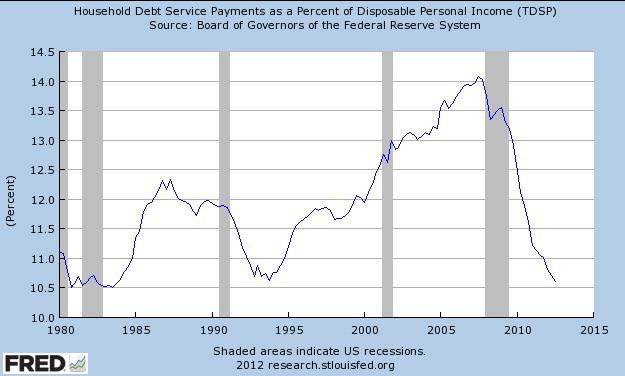
The following quote from a recent Reuters article illustrates the typical interpretation of this chart:
A measure of the burden of household debt tumbled in the third quarter to its lowest level in 29 years, which should help free up money for consumer spending and support the economy.
Allow me to say that it is unquestionably true that the less money Americans need to devote to debt service payments, the more they will spend on other items, all things equal. The problem is that in the "New Normal" (a phrase coined by PIMCO's Mohamed El-Erian to describe the post-crisis environment), all things are not equal.
Richer By Default
Before discussing the reason for the outsized decline in the household debt service ratio, it should be reiterated here that households didn't take any proactive steps to achieve the "balance sheet repair" that everyone seems so pleased with. In reality, households deleveraged by default (both figuratively and literally). As I noted in a previous article, it is likely that all of the deleveraging in terms of households is attributable to defaults or write-offs. Here is a quote I have used before from Morgan Stanley's Gerard Minack:
Just as the rise in leverage was built on using debt to buy assets, deleveraging has largely put that process in reverse. Debt reduction can be financed by asset sales or, if that's not feasible, debt write-down. Estimates for mortgage defaults center around $1¼-½ trillion - implying that defaults account for all the net reduction in household debt."
For those who have to see something with their own eyes to believe it, consider the following graph which, utilizing data from the NY Fed, shows the change in mortgage debt alongside the amount of charge-offs for the same periods:
(click to enlarge)
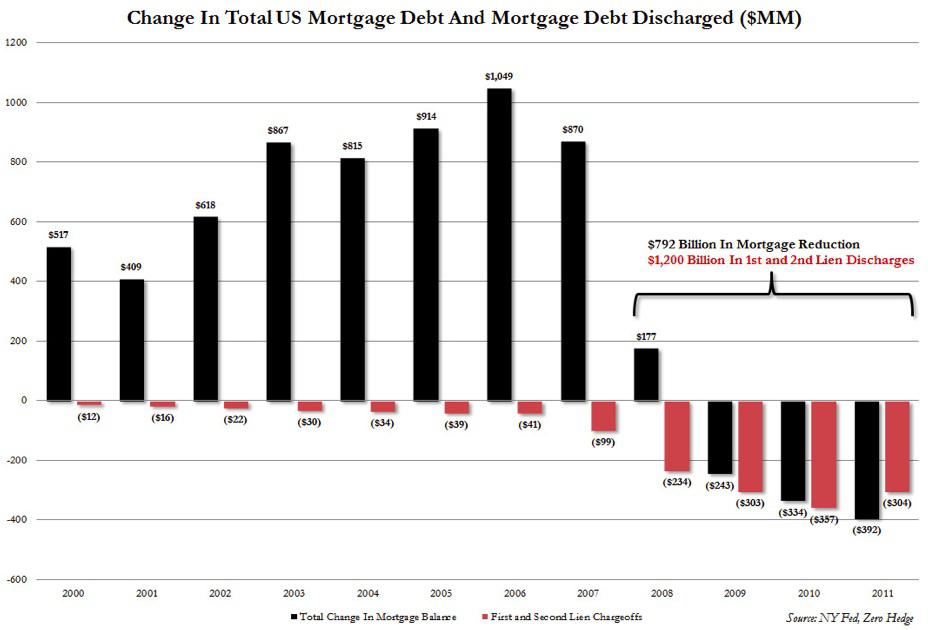
The often celebrated "healthy deleveraging" appears to have been nothing more than a giant default party. Even those who have written optimistically about the prospects for the American consumer like Bloomberg BusinessWeek's Chris Farrell recognize this sobering reality:
To be sure, about two-thirds of the gain in household balance sheets has come through mortgage foreclosures and credit-card defaults.
More Spending?
Be that as it may, one might still wonder why, given that a lower household debt service ratio necessarily means more unencumbered disposable income, one shouldn't expect consumer spending to rise. In other words, regardless of the reason for the deleveraging, more money should mean more spending.
Not this time. Homeowners or, perhaps more aptly, former homeowners, having just experienced the financial shock of a lifetime aren't likely to simply go right back out and start spending again. As Reuters puts it (article cited above),
While a lightening of household debt burden puts the recovery on firmer ground, it also highlights a hesitance to take on new debt, which could be an obstacle to spending.
For a more academic take on the matter, consider that the Federal Reserve Board's Neil Bhutta recently analyzed the decline in mortgage debt to determine its causes and found evidence in support of both the idea that Americans are hesitant to buy a new home due to the prolonged disruption in the labor market and that reductions in mortgage debt are primarily due to defaults:
First-time homebuying appears to be quite weak [because] credit has been difficult to get. [Additionally] housing demand and the demand for mortgage debt has surely been hampered to some extent by the weak labor market. The growth in outflows can be traced largely to financially distressed borrowers exiting the mortgage market entirely either through sale or default.
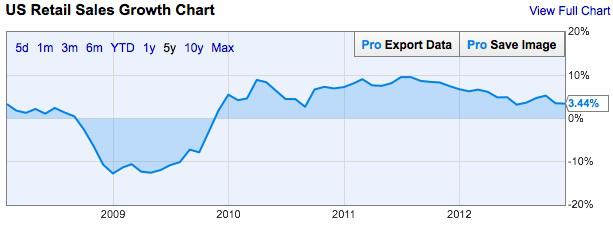
If people aren't going to run out and buy a house with their extra money because they are still shell shocked by the crisis, maybe they'll use their new-found surplus of disposable income to simply go shopping instead (let's assume for now that the holiday shopping season numbers didn't just miss expectations by a mile). Not according to the data for U.S. retail sales growth:
(click to enlarge)
Source: YCharts
According to data from the advanced monthly retail trade report which was used to construct the chart above, retail sales growth fell 54.29% on a year-over-year basis in November and is currently running at 3.44% or 25.4% below its long-term average year-over-year growth rate of 4.61%.
Household Debt Service Ratio
Above and beyond the preceding discussion, the real issue with the household debt service ratio is what CreditWritedowns' Edward Harrison calls "the debt service mentality." Harrison notes that:
During the boom and bubble which led up to the financial crisis, many in the financial community looked to debt service costs in the private sector as the only relevant metric to gauge whether debt levels were sustainable.
Harrison describes two theoretical home buyers (Bob and Shirley) who watch as the value of the home they can afford skyrockets as interest rates decline. The problem is that when debt service costs are the only relevant metric, low interest rates paint a false picture of one's financial well-being:
The lower interest rates go, the more affordable any debt load becomes when debt servicing costs are the only constraint. As rates drop toward zero percent, theoretically Bob and Shirley could afford to buy practically any house. But, of course, interest rates don't move in one direction.
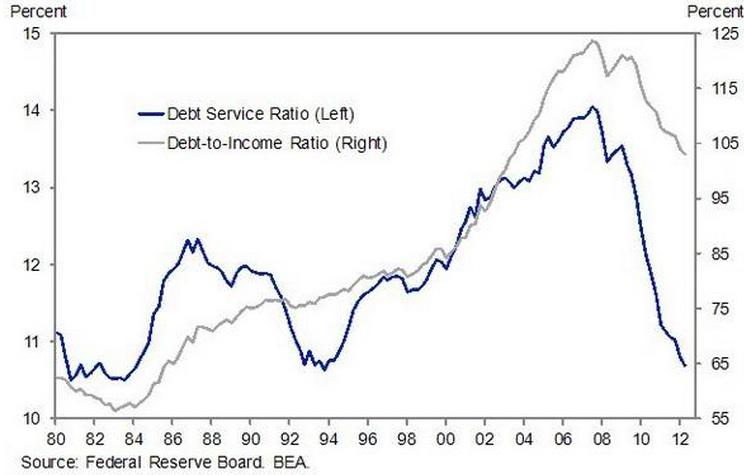
Beware, because this is where the curtain gets pulled back. Have a look at the following chart from Goldman which shows the debt service ratio plotted with the debt-to-income ratio:
(click to enlarge)
Source: Goldman Sachs, Fed
As you can see, it's not the deleveraging that's made the difference. It's the record low interest rates that have made the large debt loads suddenly manageable. Here's Reuters again:
The Fed has sought to help consumers dig out by keeping interest rates near record lows. It has held overnight rates near zero since December 2008 and has bought around $2.4 trillion in bonds to further lower borrowing costs.
As the chart shows, however, Americans' debt-to-income ratio is still above 100% meaning that, according to Reinhart and Rogoff, if American households were countries, they would be in trouble.
The important point is this: if low interest rates were largely responsible for driving down the household debt service ratio (and it appears, given the chart above that this is the case) and rates are currently at zero, it stands to reason that the debt service ratio will go up from here. The only way to escape this conclusion is if Americans deleverage more or start making more money. But neither of these two alternatives seem likely given that 1) there really was no deleveraging in the first place (it was mostly defaults) and 2) wage growth is at historic lows.
What I hope to have demonstrated here is that investors concerned about the outlook for the U.S. economy going into 2013 should be skeptical of overly enthusiastic interpretations of the household debt service ratio. The recent reading for that particular data point is widely heralded as proving that the U.S. consumer now has the financial wherewithal to fuel a consumption-driven recovery. This interpretation is highly misleading.
Investors should remember that the driving forces behind the great deleveraging and the improvement in the household debt service ratio are mortgage defaults and record low interest rates respectively. A country cannot default its way to prosperity anymore than it can print its way to prosperity or become richer by manipulating interest rates. It hasn't worked for the last four years and it won't work in 2013. Expect below average economic growth and similarly disappointing equity returns from (SPY) and (QQQ), as the two will form a negative feedback loop the exact opposite of the wealth effect the Fed so desperately seeks to create.
 

2013 Outlook: Lex Parsimoniae


"There are known knowns; there are things that we know
There are known unknowns; that is to say there are things that we now know we don't know"
But there are also unknown unknowns - there are things we do not know we don't know"
-Donald Rumsfeld, U.S. Secretary of Defense, 2002
The economic and market environment remains as uncertain as ever as we move into 2013. One does not have to look far to find extreme risks that could propel us sharply in either direction at any given moment in time. Given these vast complexities, examining investment markets as a whole can lead to many conflicting signals. Thus, it is worthwhile to break the market down into isolated component parts to determine what is known as fact and what must be predicted. And by working to simplify the markets, it should ultimately lead to a greater understanding of what we can expect from investment markets in the coming year.
The Known Knowns
The following forces are known as fact for investment markets in the coming year. And none is more significant than the first.
Extremely Aggressive Monetary Policy - One fact we know heading into the New Year is that the U.S. Federal Reserve is ready to print money with wild, perhaps reckless, abandon. Overall, the Fed will inject more than $1 trillion into financial markets in 2013 as part of its QE3 program at a rate of $85 billion per month. And the Fed money printing is likely to be joined along the way by major programs from the European Central Bank, the People's Bank of China and other major global central banks. In recent years, such aggressive monetary stimulus programs have driven investment markets higher regardless of economic fundamentals or persistent threats of crisis. And given the scale of monetary stimulus in the coming year, it is likely that we may see more of the same in 2013. While some have questioned the efficacy of QE3 in this regard since its launch in September 2012, it is important to note that relatively little liquidity has been injected into the financial system to date under this program. This is set to change in a big way starting in January 2013, however, as U.S. Treasury purchases are added just as mortgage backed securities purchases under the existing program begin to pick up speed. In terms of investment impact, this should benefit stocks, high yield bonds and precious metals including gold and silver most. These gains are likely to come at the expense of U.S. Treasuries, particularly Long-Term U.S. Treasuries, as capital flows out of the safety of U.S. government bonds and into risk assets.
Taxes Are Going Up - Regardless of what direction fiscal policy makers chose in Washington DC over the coming year, one thing we know for certain is that taxes are going up. While the impact of these higher taxes may impact certain income earners more than others, everyone in the U.S. will be paying more in taxes than they have in previous years, even if it's 2% more out of their paycheck once the payroll tax cut expires. And if consumers and businesses are sending more of their money to the government to pay taxes, they have less money left over to spend on consumer and capital goods. This is likely to place a drag on economic growth in the coming year, which should presumably weigh on stocks and high yield bonds in favor of precious metals and U.S. Treasuries. But the heavy flow of liquidity from the Fed may help investors to ignore such fundamental truths for yet another year.
Fiscal Policy Paralysis - A fact that is repeatedly reinforced by the Federal government in Washington is that absolutely nothing of substance is going to be accomplished in addressing the critical issues facing the U.S. economy until politicians are up to their knees in the fire of the problem. And even then they are likely to find a way to dither. The recent fiscal cliff debacle highlights this point, as the media has been captivated by a debate over policy solutions that do not even begin to scratch the surface of the underlying problem. For example, the Federal debt has increased by $6 trillion over the last five years, yet we have been tortured for over nearly two months on a debate that struggles to implement even $100 billion in spending cuts. In short, nothing is going to come out of Washington to try and tackle the problems facing the U.S. economy in 2013. Instead, solutions will finally come under consideration down the road when it's potentially too late.
The European Crisis Remains Unresolved - The seeds of the European crisis were sown years ago and began manifesting themselves during the outbreak of the financial crisis back in 2008. And the problem has continued to get worse with each passing year. In 2010 the problem was Greece. By 2011 it had spread to Ireland and Portugal. And in 2012 it had fully infected Spain and Italy. As debt problems continue to mount, economic growth remains insufficient to begin to reverse the trend, particularly as the global economy continues to slow. While coordinated global monetary stimulus may help markets ignore the festering problem across Europe for another year, the problems facing the region and subsequently the world continue to mount. But just like the Fed in the U.S., the ECB appears to stand ready to throw more and more money at the problem. While one cannot solve a debt problem with more debt, the Europeans appear determined to continue trying.
Known Unknowns
The following are forces that are known uncertainties that require careful monitoring and evaluation as the year progresses.
The Global Economy - All signs point to further slowing and the potential for recession in many parts of the world in the coming year. But it remains possible that growth could surprise to the upside, particularly depending on the magnitude of monetary stimulus injected into the global economy in 2013. Any such growth may prove fleeting, but it has the potential to influence investment markets and not necessarily for the better, for it may raise inflation concerns and the thought that monetary policy makers may withdraw stimulus sooner rather than later, which of course they will almost certainly not in the end.
Corporate Profits - Corporate profits have begun slowing with margins already at post WWII highs. And with the global economy set to decelerate in the coming year, many signs suggest that we are likely to begin seeing meaningful profit margin compression as companies have little scope for further cost cuts. Corporations have defied this trend thus far, but it remains to be seen how much longer they can continue to maintain profitability and margins at current levels during the quarterly earnings seasons throughout 2013. Of course, the potential always exists for upside surprise as well, although the odds are becoming increasingly low for such outcomes.
Inflation - When central banks inject as much money as they have over the last several years into the global economy, inflation is an issue that should remain of paramount concern. While policy makers cite that inflation pressures remain largely contained to this point, one could quibble with whether current inflation measures are truly capturing actual pricing pressures. And once inflationary pressures take hold, they can be difficult to contain without a hard press on the monetary brakes. Such a response, of course, has the potential to sharply rattle investment markets.
And the last known unknown is arguably the most important.
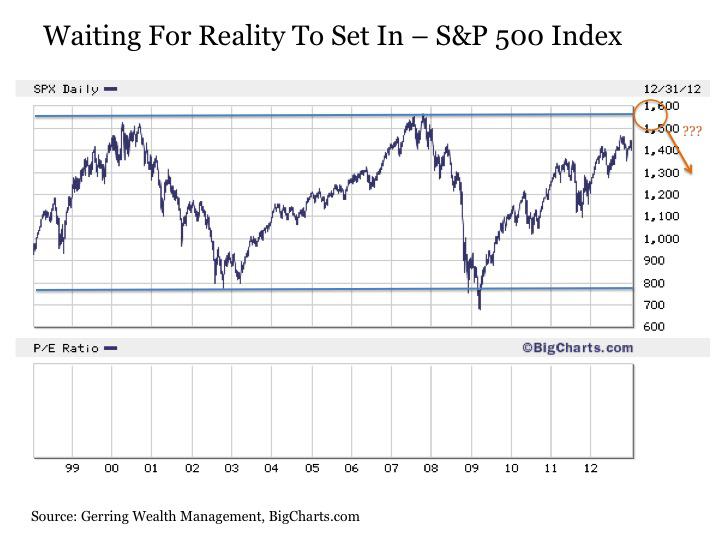
When Reality Finally Sets In - Investment markets have floated higher for years under the influence of monetary stimulus. For the freely flowing money from global central banks including the Fed has enabled investors to completely ignore the fact that little has fundamentally improved since the outbreak of the financial crisis several years ago. In fact, much has gotten worse and precious time and resources have been squandered along the way. At some point, investment markets will finally awaken to the reality of the situation. Exactly when that will occur and what the final catalyst will be remains to be seen, but we will eventually arrive at this inflection point someday. Perhaps this moment will come when stocks arrive at a triple top around 1576 on the S&P 500 Index. But more likely, it will come quietly one day when the market least expects it. Whether this occurs in 2013 or beyond remains to be seen.
(click to enlarge)
Unknown Unknowns
It is the unknown unknowns, or the potential problems that we are not even aware that we should be monitoring, that have the greatest potential to result in a sudden and dramatic shift in investment markets. Potential candidates include the following.
Another Flash Crash - Investment markets have been infested in recent years by high frequency trading programs, which are computer driven models that result in quotes and trades being executed down to the millisecond. We have seen a number of instances in recent years where a breakdown or defect in these models has resulted in highly unusual and disruptive trading activity. While most of these incidents to date have occurred on a small scale, the potential exists for a large-scale market disruption on any given day.
Institutional Meltdown - A good deal of trading activity today occurs in the darker corners of the market, and the potential continues to exist for another Long-Term Capital Management or London Whale type unraveling where a select group of traders or a hedge fund takes on a disproportionately large position that threatens to destabilize a major financial institution or the entire global marketplace. One would have hoped in the aftermath of the financial crisis that measures would have been undertaken to diffuse these risks. But unfortunately, such activities continue to go unabated if not encouraged in the current environment.
Geopolitical Event - Numerous challenges exist across the global political landscape. The situation in the Middle East remains highly unstable with new leadership assuming power in a number of countries across the region. And the recent events in Benghazi have reinforced the idea that the threat of terrorism remains pronounced. Such events have meaningfully disruptive effects on investment markets at any given point in time.
Such is the economic and investment landscape as we enter 2013. It is an environment that is fraught with risk and must be managed carefully. But when considering all of these factors both in isolation and then collectively, we can draw the following conclusions.
Bottom Line
The Fed is set to stimulate aggressively in the coming year by printing over $1 trillion. And other global central banks are likely to join in along the way with major stimulus programs of their own. History has shown that during periods when monetary stimulus is being applied so aggressively and at such a massive scale, risk assets including stocks, high yield bonds and commodities will steadily rise regardless of how fundamentally weak the economy and corporate profits may be. Thus, until this trend is definitively broken, it should be expected to continue.
This notion, of course, raises and important question. What exactly could definitively break the trend of aggressive monetary stimulus supporting higher risk asset prices? The answer is a number of forces may cause reality to finally set in on investment markets, and they all require close monitoring throughout the coming year. These forces include the ongoing crisis in Europe, the potential magnitude of an economic slowdown or corporate profit contraction, the outbreak of inflationary pressures, or some other event that cannot be reasonably anticipated at the present time.
Thus, a hedged investment strategy remains prudent as we enter the New Year. An allocation to risk assets such as stocks, high yield bonds and commodities including copper, oil, agriculture, gold (GTU) and silver (PSLV) are all warranted given the degree of money set to be printed in the coming year. A position in TIPS (TIP) also makes sense along with precious metals and senior loans (BKLN) to protect against the threat of inflation and rising interest rates. But in recognition that downside forces may eventually overwhelm the investment market euphoria over monetary stimulus or that the stark reality that underlying fundamentals remain woefully insufficient to support stocks and other risk assets at current levels, it also remains worthwhile to complement these exposures with allocations to areas of the market that should perform well under these circumstances. This includes high quality nominal bonds (AGG), long-term U.S. Treasuries and other longer duration assets such as Build America Bonds (BAB). Holding allocations in cash or short-term bonds at selected points in time may also be warranted depending on the swiftness or seriousness of a change in market conditions at any point in time.
The coming year promises to provide more interesting times for investment markets and its participants. But a broadly diversified strategy with components that are designed to participate in any further Fed induced upside but can also withstand any unexpectedly sharp and dramatic turns along the way remains a prudent approach in the current environment.
This post is for information purposes only. There are risks involved with investing including loss of principal. Gerring Wealth Management (GWM) makes no explicit or implicit guarantee with respect to performance or the outcome of any investment or projections made by GWM. There is no guarantee that the goals of the strategies discussed by GWM will be met.
 

Have Uranium Miners Hit Rock Bottom?


Almost two years after the Fukushima nuclear disaster, uranium miners are still struggling. Spot prices for uranium are less than a third of their 2007 highs while volumes have been dismal. Power generators have sufficient near-term inventories and a jump in the spot price can't be anticipated any time soon. Reaction to Fukushima has sparked a backlash against nuclear power, with Germany planning to phase out all of its nuclear generators by 2022, and France debating a measure to close 24 reactors by 2025. But even in this environment, the future of uranium is not all bleak and opportunities exist for long-term growth.
The World Nuclear Association reports that 65 reactors worldwide are presently under construction, with an additional 485 either planned or proposed. Most of that development is from China, India and Russia, which combined are building 46 new reactors with a staggering 273 plants planned or proposed. China alone is constructing 29 plants.
Fabrication of a nuclear facility is a long-term venture. In India, for example, laws assign liability to plant builders, rather than to reactor vendors. This anomaly to the international standard has made some contractors reluctant to engage in India and the pace of construction has slowed. But this has not deterred the development of trade agreements, as Canada and India are close to a long-term accord which would allow Canadian companies to sell nuclear materials to India.
In the meantime, supplies can be expected to contract, as uranium miners, notably Cameco (CCJ), slow greenfield development. Companies have indicated that new expansion will be dictated by spot price. In addition to scale-backs and lowered production estimates from the miners, there is the winding down of the Highly Enriched Uranium (HEU)agreement, which provided for Russian weapons-grade uranium to be recycled into fuel-grade uranium. Cameco's CEO Tim Gitzel noted that Russian withdrawal from the agreement by the end of 2013 will remove 24 million pounds from global supply annually.
So when will projected decreasing supplies of uranium clash with increasing demand from new plants coming on-line? Dennis da Silva, fund manager at Middlefield Capital, thinks the price could strengthen in late 2013 or early 2014. He pointed out that Australian-based Paladin Energy (PALAF.PK) signed a large supply contract in 2012 that begins in 2019, perhaps an indication of when it believes the uranium market will be flourishing.
Surprising the world, Japan's new prime minister Shinzo Abe has signaled a reversal of the previous government's policy of facilitating a phase-out of nuclear power. While his views might not represent those of the average Japanese, it is interesting to note how quickly his support for new plants could be voiced without universal condemnation. Perhaps Abe and his supporters anticipate higher fossil-fuel prices as a result of his party's bid to devalue the yen.
While it is not advisable to hold uranium in one's physical portfolio, several equities exist from which to launch a long-term uranium strategy, safely and legally. Established pure uranium producers, Cameco, Paladin and Uranium One (SXRZF.PK), all have expanded beyond the traditional U.S.-Canada-Australia matrices, with Paladin establishing a share of African mines, while Cameco and Uranium One have developed in-situ leaching operations in Kazakhstan. Attention should be given to these jurisdictions during any analysis, with Kazakhstan recently listed by Maplecroft as possessing a high-risk potential for "resource nationalism". Paladin and Uranium One are lightly traded in U.S. OTC markets and are not optionable. For those who are more comfortable with ETF diversification, there is the Global X Uranium ETF (URA), which includes all of the above companies in its holdings. Unfortunately for options traders, this instrument is not very liquid and has wide spreads.
Assuming there will be no abatement in developing countries' commitments to building nuclear plants, and barring another Fukushima or Chernobyl, it is clear that anticipated lower supplies of uranium will eventually collide with a surge in demand once new facilities are online. Sharp and prolonged increases in fossil-fuel costs, particularly of coal and natural gas, could hasten this outcome. In a world with limited options for mass power generation, uranium has been written off too soon.
 
 
Support : Creating Website | Johny Template | Mas Template
Copyright © 2011. Economic Challenges Articles - All Rights Reserved
Template Created by Creating Website Published by Mas Template
Proudly powered by Blogger